Table of Contents
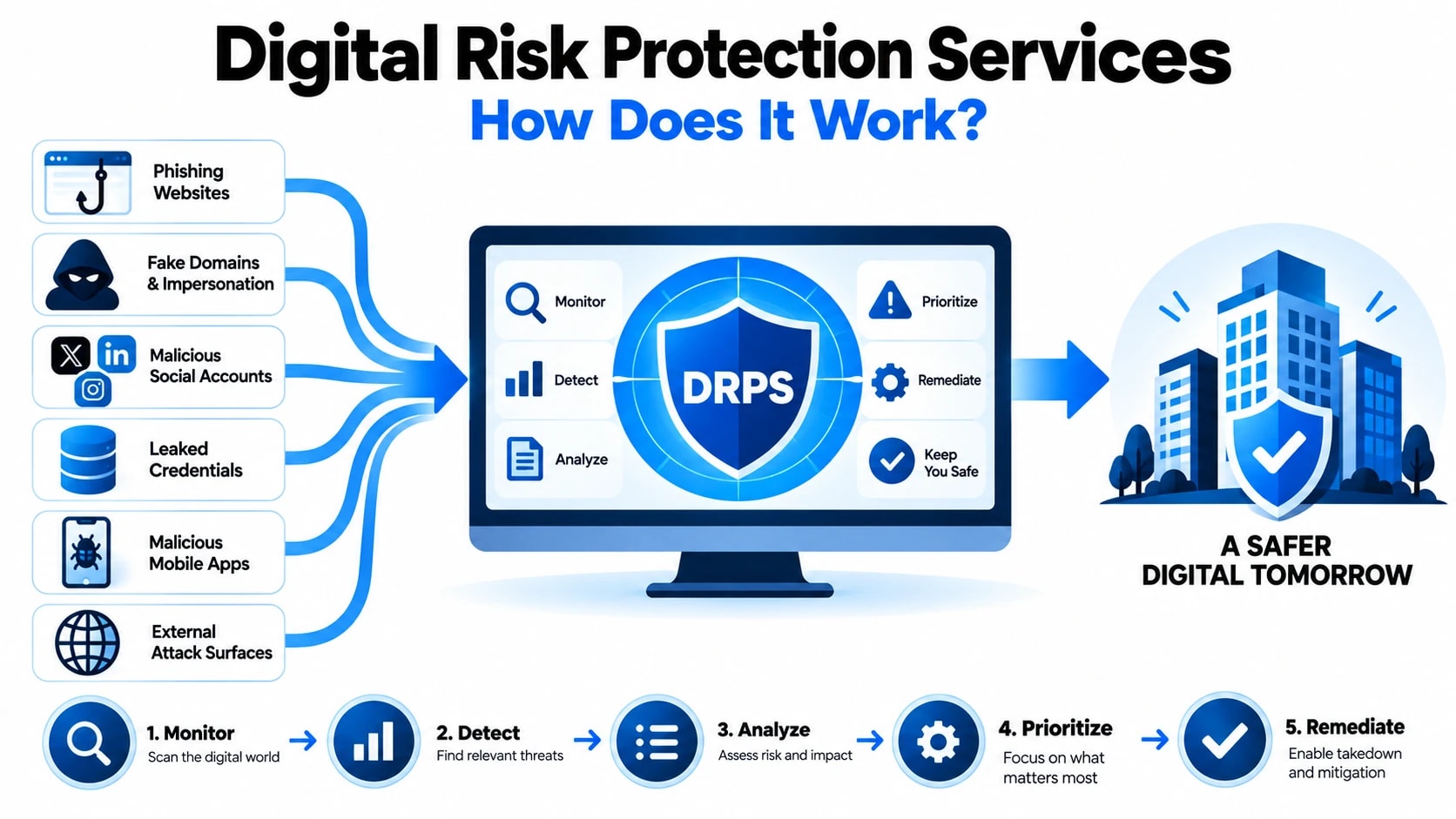
Digital risk protection services (DRPS) operate well outside the boundaries of traditional perimeter security, monitoring the open web, dark web, and technical infrastructure for signals that your organization is being targeted, impersonated, or actively exploited. Unlike reactive security controls that respond to threats after they breach your environment, DRPS functions as a continuous external surveillance layer, converting billions of unstructured data points into prioritized warnings your security team can act on immediately. Understanding the technical mechanics behind that process is critical for any organization evaluating whether these services fit their threat posture.
Read More On Nintendo Direct 2026: Security Risks & What to Watch
What Digital Risk Protection Services Actually Monitor
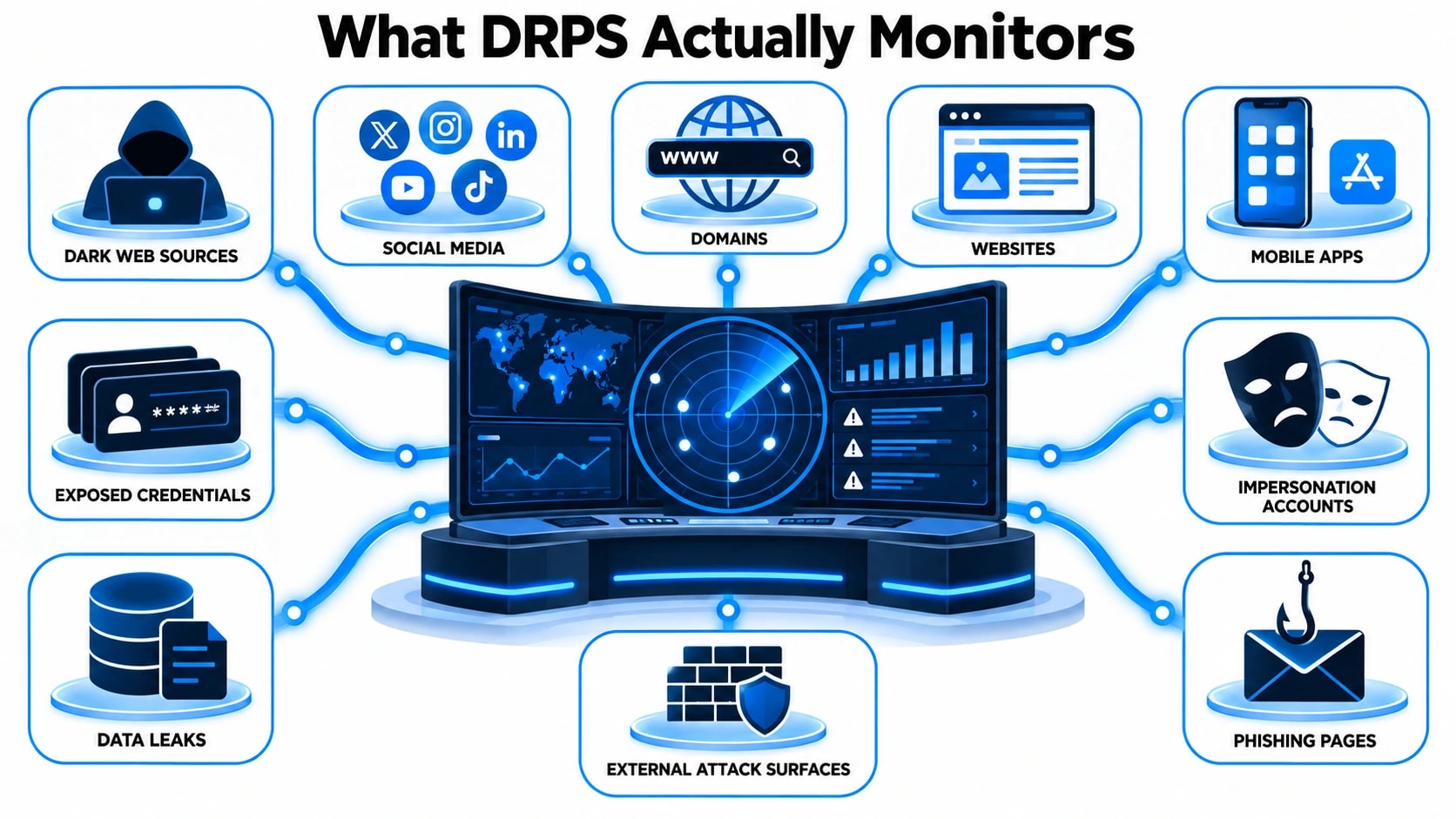
The monitoring scope of a mature DRPS platform is deliberately broad because threat actors operate across dozens of distinct channels simultaneously. Restricting collection to a single source creates blind spots that adversaries will exploit. A properly configured service ingests data across several distinct categories.
Surface web and indexed content includes brand mentions across news sites, paste sites, forums, code repositories like GitHub and GitLab, job boards, and social media platforms. Attackers frequently expose credentials, internal architecture details, or sensitive documents through accidental public commits or third-party data leaks that surface in indexed search results long before a target organization discovers them internally.
Dark web and closed forums require specialized collection infrastructure because content is not indexed by conventional search engines. This layer covers Tor-based marketplaces, private ransomware gang forums, invite-only Telegram channels, and IRC networks where stolen credentials, access listings, and planned attack campaigns are advertised and traded. Monitoring here is technically demanding because many forums require authenticated accounts, reputation scores, or invitation vouching to access.
Technical infrastructure signals cover the external attack surface directly, including newly registered domains that typosquat or spoof your brand, SSL certificate transparency logs that reveal fraudulent certificates issued in your name, misconfigured cloud storage buckets, exposed API endpoints, and BGP routing anomalies that may indicate IP hijacking attempts. This data is largely machine-generated and requires automated parsing at scale.
Credential exposure feeds aggregate data from breach compilations, stealer malware logs, and combo lists that circulate through criminal networks. These feeds are cross-referenced against your monitored domains and email patterns to identify employee or customer credentials that are actively for sale or have already been distributed.
Physical and executive threat monitoring extends protection to named individuals within an organization, tracking threatening language, doxxing attempts, and targeted phishing kit infrastructure built around executive identities. This is particularly relevant for organizations in financial services, critical infrastructure, and government contracting.
To understand Digital Risk Protection Services: How Does It Work?, it helps to compare what you see in the data and what action you need to take next.
The Technical Detection Pipeline: From Raw Data to Actionable Alert
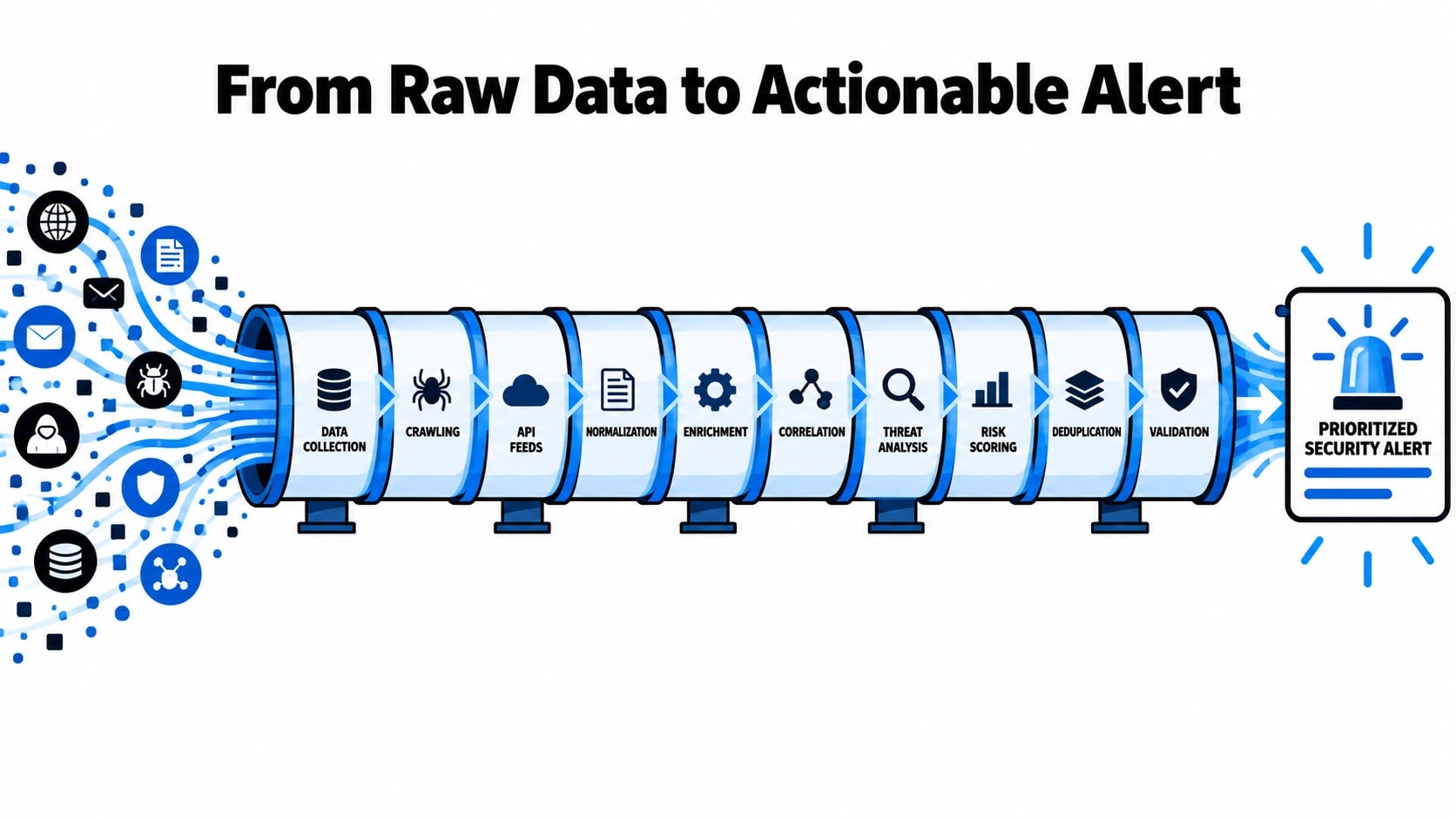
Raw threat data is operationally useless without a structured pipeline that filters noise, enriches signals with context, and routes findings to the right teams at the right time. The detection pipeline in a mature DRPS platform typically moves through five interconnected stages.
Stage 1: Collection and ingestion. Automated crawlers, API integrations, human intelligence (HUMINT) from analyst-accessed forums, and proprietary sensor networks feed raw data into a centralized ingestion layer. At this stage, volume is enormous and signal density is low. Collection must be continuous because threat actor activity follows no predictable schedule, and a credential listing that appears on a forum at 2:00 AM may be acted on within hours.
Stage 2: Normalization and deduplication. Ingested data arrives in inconsistent formats, languages, and structures. Natural language processing (NLP) pipelines normalize text, machine translation handles foreign-language sources, and deduplication logic prevents the same post or record from generating duplicate alerts. Structured data schemas tag each record with source type, timestamp, geographic indicators, and confidence score.
Stage 3: Entity extraction and asset matching. The normalized data is scanned against a customer-defined asset inventory that includes domains, IP ranges, brand keywords, executive names, product names, and email domain patterns. Entity extraction models identify relevant mentions and score them against asset priority tiers. A mention of your primary corporate domain in a dark web credential listing ranks higher than a mention of a subsidiary brand in a surface web forum post.
Stage 4: Enrichment and context layering. Matched records are enriched with additional technical context. A flagged domain is queried for WHOIS history, DNS records, hosting infrastructure, and SSL certificate data. A credential record is checked against known breach databases to determine whether it is part of a new exposure or a recycled compilation. Threat actor profiles associated with the source forum or marketplace are appended where available, providing attribution context that influences severity scoring.
Stage 5: Prioritization, alerting, and case creation. Enriched findings are scored using a combination of asset criticality, threat actor capability, data sensitivity, and potential business impact. High-priority alerts are routed immediately through SIEM integrations, ticketing systems, or direct analyst notification, while lower-confidence findings are queued for periodic analyst review. This tiered routing is what separates a functional DRPS from an alert-flooding tool that burns out security teams.
]]>
Threat Categories DRPS Is Designed to Detect
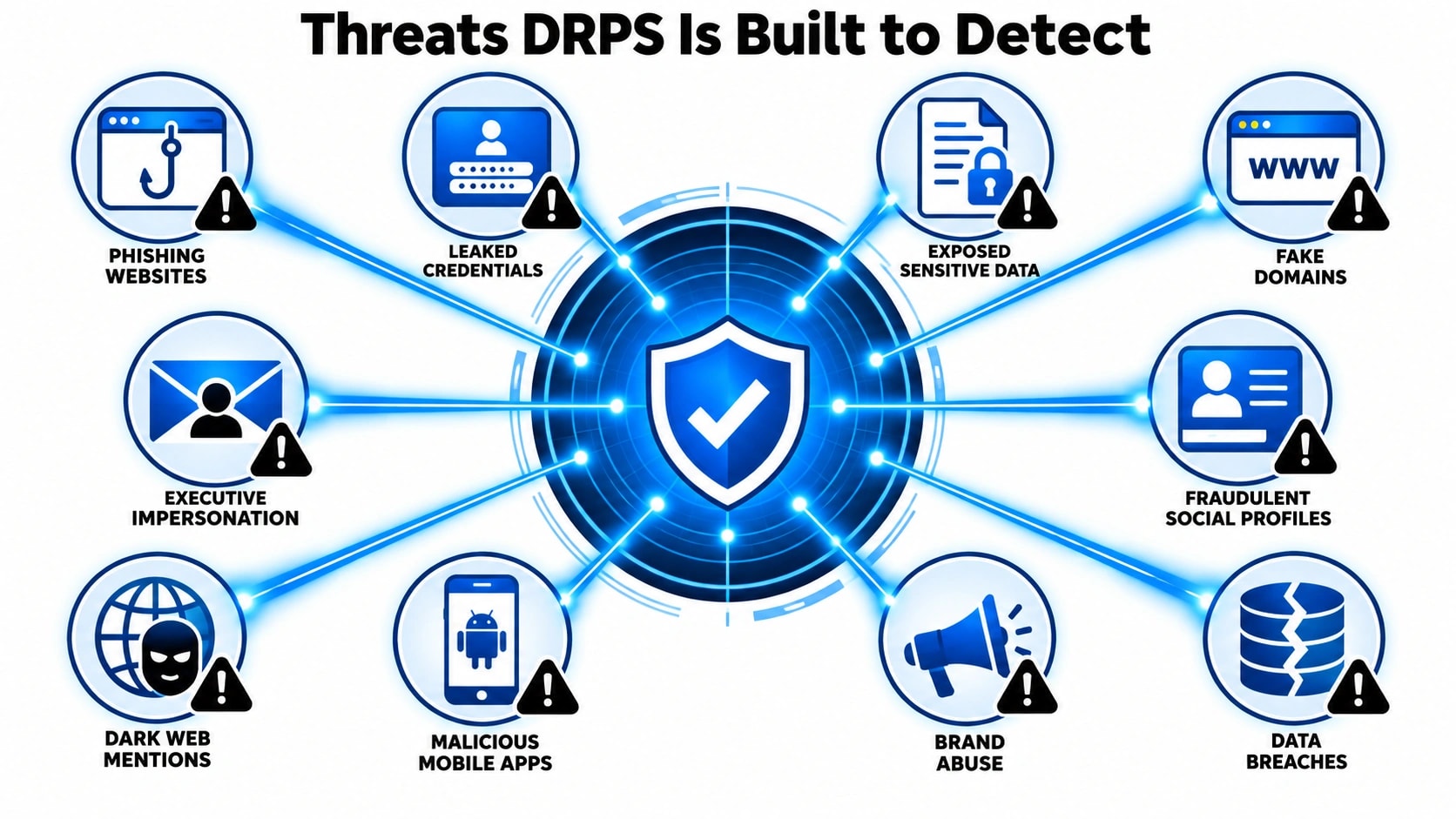
Digital risk protection services are built around a defined taxonomy of external threats, each requiring different detection logic and response workflows. The most prevalent category is brand abuse, which includes typosquatted domains, fake social media profiles impersonating executives or official accounts, and unauthorized use of logos and trademarks in phishing kits. These attacks are often the first sign that a threat actor has identified an organization as a profitable target. Without automated monitoring across domain registrars, social platforms, and app stores simultaneously, these threats can persist for weeks before anyone notices them.
Data exposure is another major category, covering leaked credentials on paste sites, source code accidentally pushed to public repositories, and employee data appearing on breach forums. This type of exposure is particularly dangerous because it creates downstream attack opportunities. A single set of valid credentials posted on a dark web forum can enable account takeover, lateral movement, and data theft, often before the affected organization even knows the data is circulating. DRPS platforms continuously index these sources and correlate findings against the client's known digital footprint, so alerts are specific rather than generic.
Beyond impersonation and data leaks, DRPS also covers threat actor activity targeting the organization directly. This includes mentions in closed forums where attack planning may be discussed, sale listings for internal access or stolen data, and early indicators of coordinated campaigns. The categories below give a structured view of what most enterprise-grade DRPS platforms are expected to cover:
Brand and domain abuse: Typosquatting, phishing pages, fake mobile apps, unauthorized trademark use
Credential and data exposure: Leaked logins, PII on paste sites, exposed API keys or tokens, code repository leaks
Executive and VIP threats: Personal data exposure, impersonation of leadership, targeted fraud schemes
Dark web intelligence: Forum chatter, access broker listings, ransomware group targeting, stolen data auctions
Third-party and supply chain risk: Compromised vendor credentials, partner domain abuse, supplier breach indicators
DRPS Deployment Models and Capability Comparison
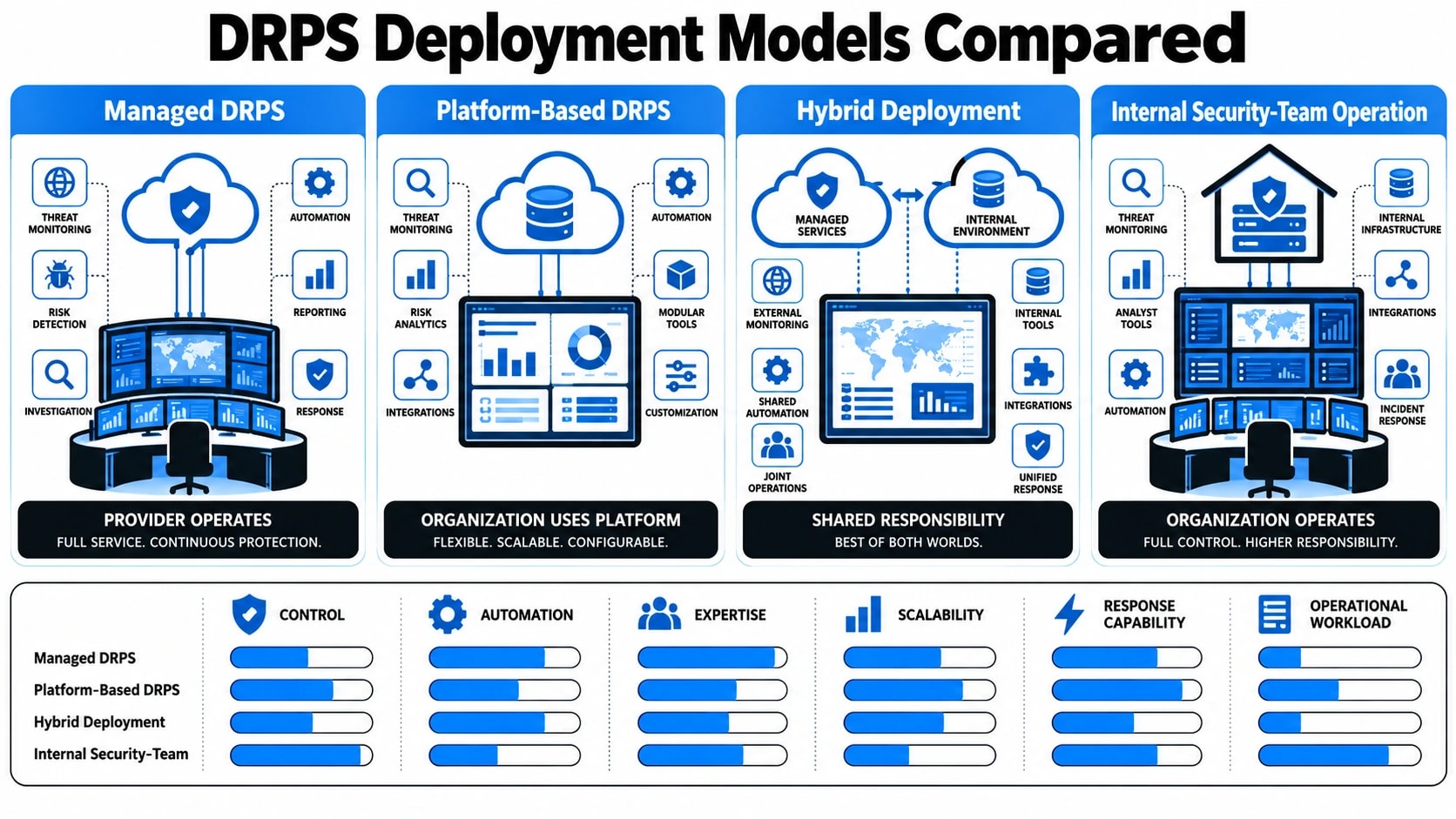
Organizations evaluating digital risk protection have three primary deployment options: fully managed service, platform-only (self-service), or a hybrid model that combines tooling with analyst support. Each model carries different tradeoffs in terms of speed, depth of analysis, and internal resource requirements. Fully managed DRPS is typically delivered through a security operations provider and includes human analysts who triage alerts, investigate context, and manage takedown requests on behalf of the client. This model suits organizations without a dedicated threat intelligence function internally.
The platform-only model gives in-house security teams direct access to monitoring dashboards, raw feeds, and alerting workflows, but requires those teams to handle investigation and response themselves. This works well for mature security programs with existing threat intelligence analysts, but can lead to alert fatigue if the platform is not properly tuned to the organization's specific assets and risk profile. The hybrid model attempts to balance both, offering a baseline of automated monitoring with optional analyst escalation for high-priority findings.
Capability | Fully Managed | Platform Only | Hybrid |
|---|---|---|---|
24/7 monitoring coverage | Yes | Depends on team | Yes (automated) |
Human analyst triage | Yes | No | On escalation |
Takedown management | Included | Manual | Partial |
Dark web intelligence | Deep coverage | Limited | Moderate |
Internal resource requirement | Low | High | Medium |
Customization flexibility | Moderate | High | High |
The Takedown and Remediation Workflow Explained
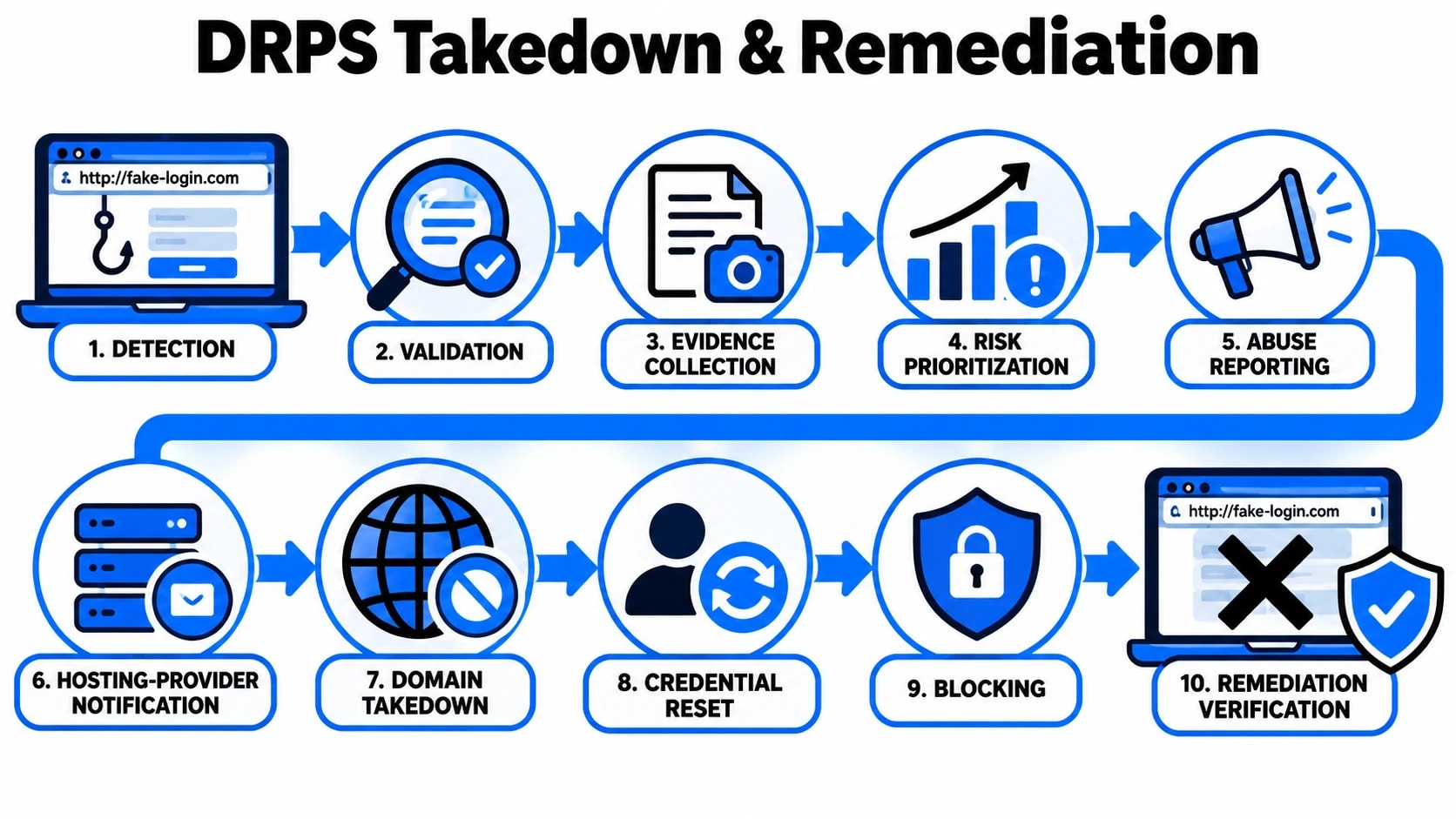
Detection is only useful if it leads to measurable action, and the takedown workflow is where DRPS delivers its most direct operational value. When a phishing site, fraudulent social media account, or malicious mobile app is confirmed, the remediation process begins with evidence collection. Screenshots, WHOIS records, hosting data, and traffic indicators are compiled into a structured case file. This documentation is critical because registrars, hosting providers, and platform trust and safety teams all require specific evidence formats before acting on removal requests.
From there, the takedown request is routed to the appropriate party. For phishing domains this typically means contacting the hosting provider's abuse team, submitting to blocklists like Google Safe Browsing and industry abuse feeds, and in parallel notifying the registrar. For social media impersonation, platform-specific reporting mechanisms are used, often supplemented by direct escalation channels that managed DRPS providers maintain with major platforms through established abuse relationships. Average takedown times vary significantly by platform and threat type:
Phishing domains: 4 to 48 hours depending on hosting provider responsiveness
Social media fake profiles: 24 to 72 hours via standard reporting, faster with escalation channels
Fraudulent mobile apps: 3 to 7 days for app store removal review
Dark web forum posts: Takedown not typically possible, mitigation focused on monitoring and credential resets
After a takedown is completed, the remediation workflow does not stop there. Post-removal monitoring is applied to detect re-registration of similar domains or re-creation of fraudulent accounts, which is a common tactic used by persistent threat actors. Internally, the incident feeds into asset inventory updates, and if credentials were involved, forced password resets and session invalidation are recommended. This closed-loop process is what separates reactive incident response from a structured external threat management program, and it is a core part of what mature providers like Cyberlad build into their SOC-integrated threat intelligence delivery.
Integrating DRPS With Your Existing Security Stack
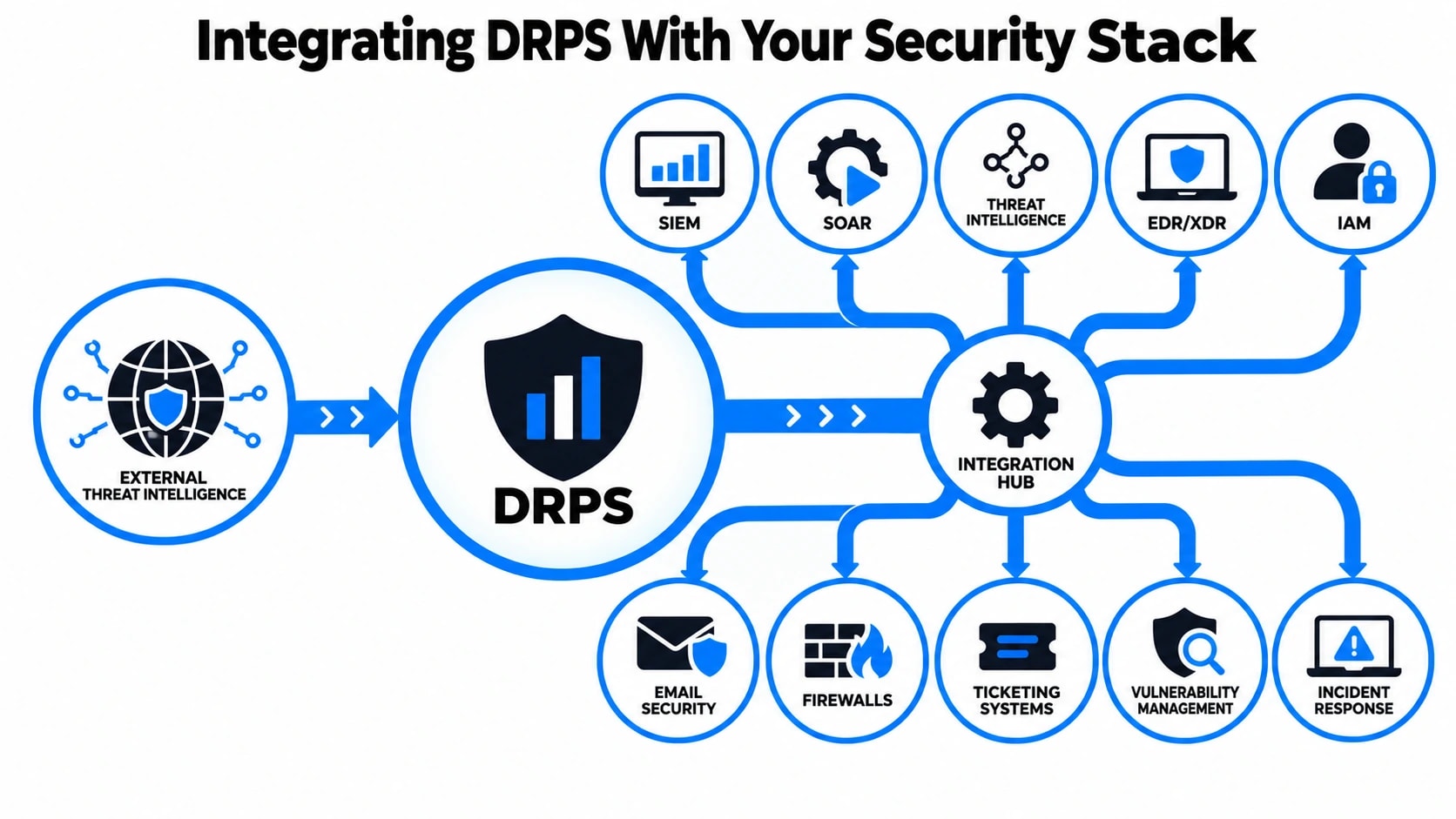
Digital Risk Protection Services do not operate in isolation. Their value multiplies significantly when they feed into the tools and processes your security team already uses. A DRPS platform that sits disconnected from your SIEM, SOAR, or threat intelligence feeds creates alert noise without operational benefit.
Effective integration typically covers several layers of your existing infrastructure:
SIEM integration: DRPS platforms push structured alerts, enriched with context such as actor attribution, confidence scores, and asset mapping, directly into your security information and event management system. This allows analysts to correlate external threat signals with internal log data.
SOAR playbook triggering: When a DRPS alert meets a defined threshold, it can automatically trigger a response playbook. For example, a confirmed credential exposure can kick off a forced password reset workflow without manual intervention.
Threat intelligence platform (TIP) enrichment: Indicators of compromise pulled from DRPS monitoring, such as phishing domains, malicious IPs, and attacker infrastructure, feed directly into your TIP for blocking and correlation.
Ticketing and case management: Alerts translate into tracked incidents inside platforms like ServiceNow or Jira, giving teams a clear audit trail for remediation actions.
Identity and access management (IAM) systems: Exposed credentials identified through dark web monitoring can trigger account lockdowns or multi-factor authentication challenges automatically.
The following table outlines how DRPS data enriches each integration point:
Integration Target | DRPS Data Supplied | Operational Outcome |
|---|---|---|
SIEM | Enriched alerts with actor context | Faster triage and reduced false positives |
SOAR | Structured threat events with severity scores | Automated response playbook activation |
TIP | IOCs: domains, IPs, hashes | Proactive blocking across network controls |
IAM | Exposed credential records | Automated account lockdown or MFA enforcement |
Ticketing system | Incident data with remediation guidance | Tracked, auditable response workflows |
When DRPS is wired correctly into your stack, external threat visibility stops being a reporting exercise and becomes a live operational control.
Measuring DRPS Effectiveness: Metrics That Matter
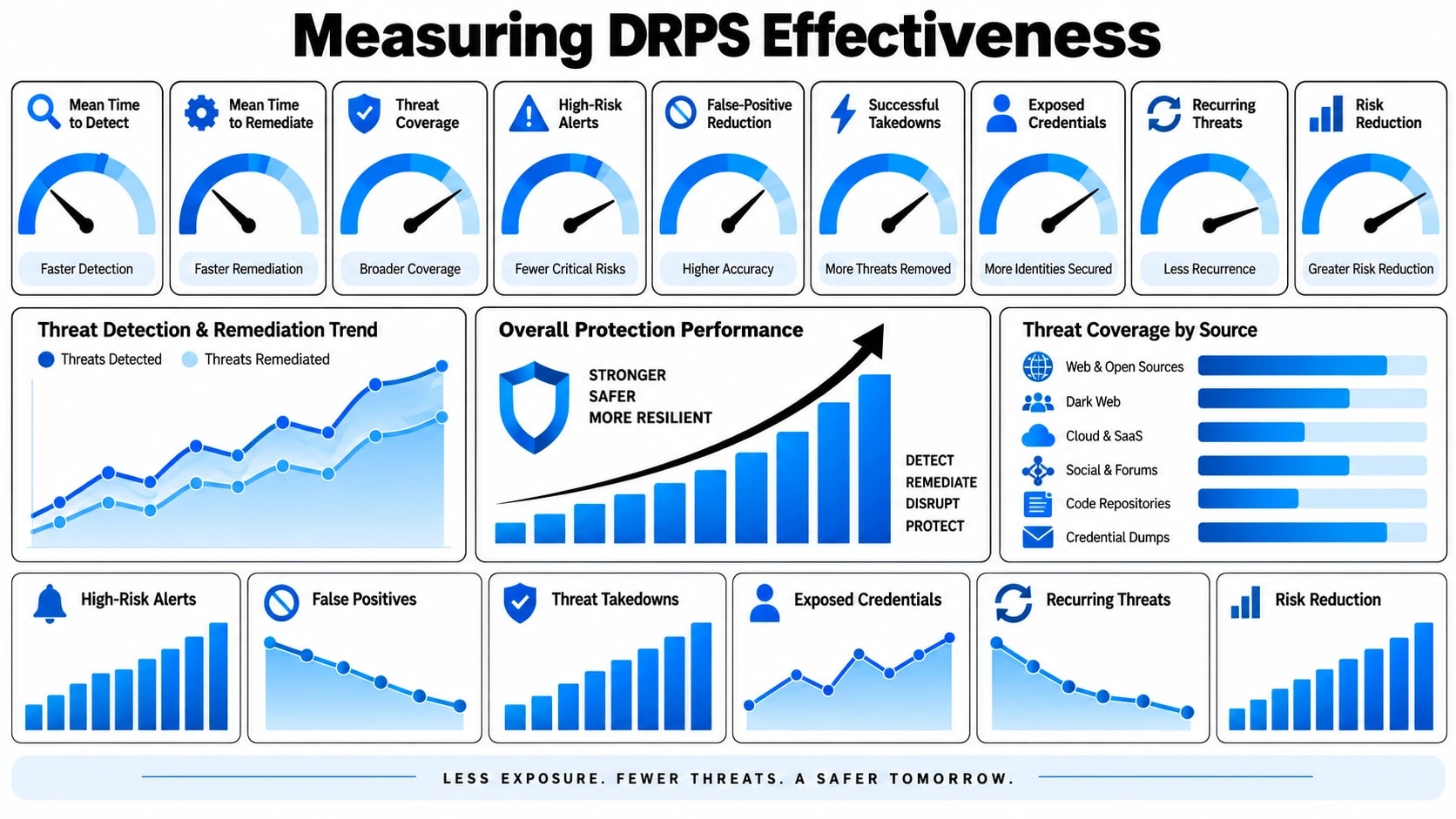
Buying a DRPS platform is only the first step. Understanding whether it is actually reducing your exposure requires clear, measurable criteria. Many organizations struggle here because they track activity metrics rather than outcome metrics. Volume of alerts generated tells you very little. What matters is what happens after detection.
The metrics worth tracking fall into three categories:
Detection speed: How quickly does the platform surface a threat after it appears externally? For phishing domains, the window between domain registration and first victim contact can be under 24 hours. Mean time to detect (MTTD) should be measured in hours, not days.
Takedown success rate: What percentage of reported phishing sites, fraudulent social media profiles, and infringing content are successfully removed? A high false positive rate on takedown requests damages relationships with registrars and hosting providers, slowing future removals.
Coverage breadth: Is the platform monitoring all relevant surface areas including the clear web, dark web forums, paste sites, code repositories, and social media channels specific to your industry?
Alert fidelity: What proportion of alerts require analyst action versus being dismissed as noise? A strong DRPS platform should deliver high-fidelity signals with context attached, not raw data dumps.
Risk reduction over time: Is the number of active external threats against your organization trending downward quarter over quarter? This is the ultimate measure of program maturity.
Mean time to remediate (MTTR): How long does it take from initial detection to confirmed resolution? This combines platform speed, analyst efficiency, and third-party takedown timelines.
Reviewing these metrics quarterly allows your team to identify gaps in coverage, adjust monitoring priorities, and demonstrate program value to leadership without relying on anecdotal evidence.
Who Needs DRPS and When to Prioritize It
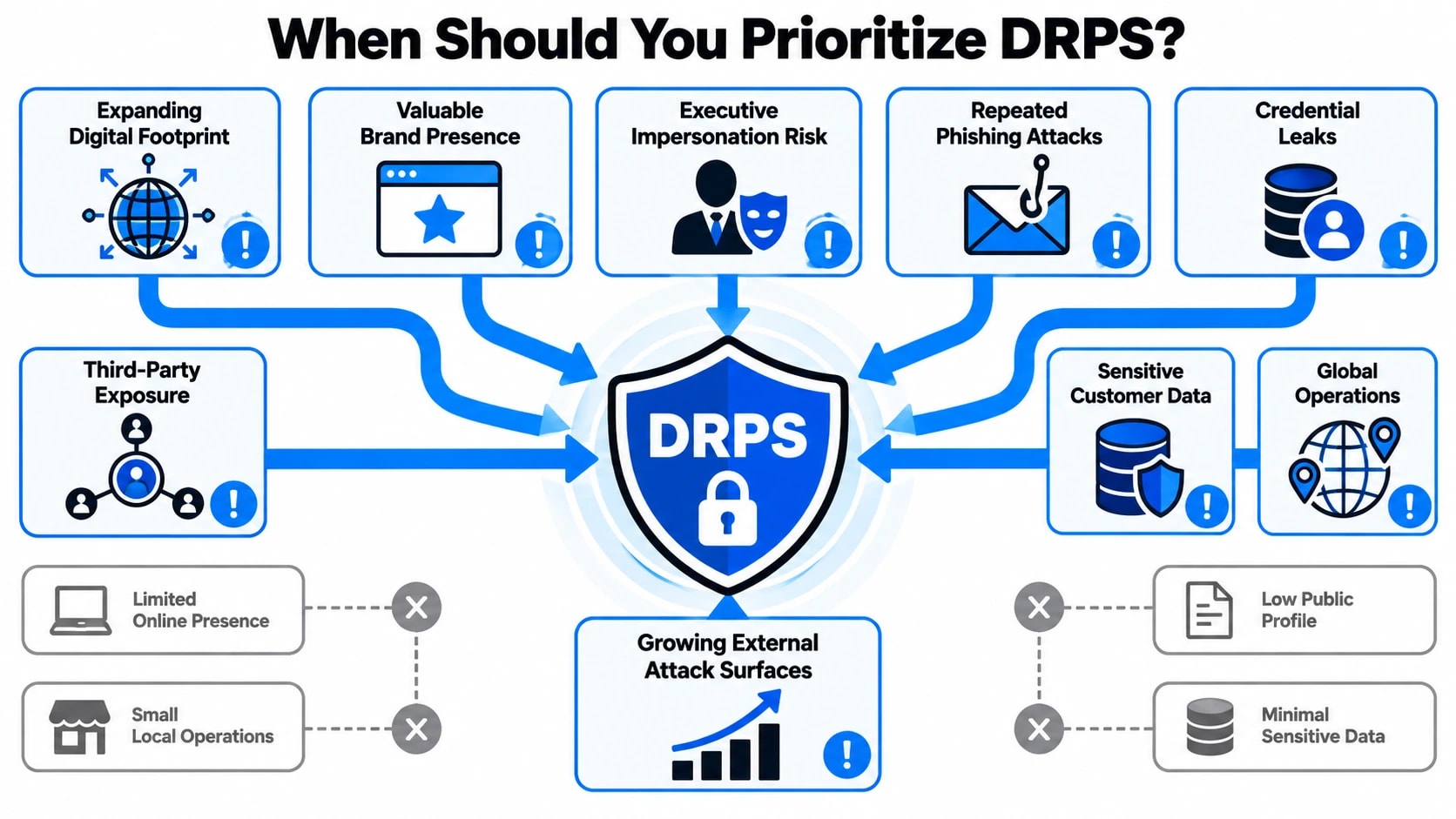
Digital risk protection is not exclusively a large enterprise concern. Any organization with a public-facing brand, customer data, or online presence carries external digital risk. The question is not whether threats exist but whether you have the visibility to catch them before they cause damage.
Certain profiles indicate that DRPS should move up the priority list:
Financial services firms: High-value targets for credential theft, banking trojans, and fraudulent app impersonation. Regulatory obligations around customer protection add further urgency.
Retailers and e-commerce brands: Brand impersonation through fake storefronts and counterfeit product listings represents both revenue loss and customer trust erosion.
Healthcare organizations: Patient data commands high prices on criminal marketplaces. Dark web monitoring for leaked records is a near-mandatory control given breach notification requirements.
Technology companies: Source code leakage through public repositories and employee devices exposes proprietary systems and creates supply chain risks.
Government and critical infrastructure: Targeted by nation-state actors and hacktivist groups, often with long dwell times before public exposure.
Any organization post-breach: Following a security incident, external monitoring should be treated as an immediate priority to track threat actor activity referencing the breach and catch follow-on attacks.
Organizations that are earlier in their security maturity journey may find that a managed DRPS service, delivered by an experienced provider, offers faster time to value than building internal capability from scratch. The combination of specialized tooling and analyst expertise closes gaps that internal teams often cannot cover with existing resources.
Conclusion
Digital Risk Protection Services address a fundamental blind spot in traditional security programs: the threats that form, grow, and execute entirely outside your controlled environment. From credential exposure on dark web forums to phishing infrastructure built around your brand, the attack surface that exists beyond your firewall is real, active, and expanding. DRPS provides the collection, analysis, and response capability needed to act on those threats before they reach your customers, employees, or systems. When integrated with your existing security operations, it transforms external threat data into measurable, operational risk reduction.
If your organization currently has no structured visibility into what threat actors are saying, building, or selling about you online, that gap is worth closing now rather than after an incident forces the issue. The team at Cyberlad works with organizations to scope, deploy, and operationalize digital risk protection programs that fit their specific threat profile and security maturity. Getting started with an external exposure assessment is a practical first step toward understanding exactly what you are currently missing.
Frequently Asked Questions
How is DRPS different from a traditional threat intelligence feed?
Threat intelligence feeds supply raw indicators like malicious IPs and domains. DRPS goes further by monitoring for threats specific to your organization, such as brand impersonation, leaked credentials, and targeted attack chatter, and then actively works to remediate those threats through takedowns and analyst-guided response actions.
How long does it take to see results after deploying a DRPS platform?
Most organizations begin receiving actionable alerts within the first one to two weeks as the platform indexes your monitored assets. Dark web and paste site monitoring may surface historical exposures almost immediately. Full operational maturity, including integrated response workflows, typically takes 60 to 90 days to establish properly.
Can DRPS help with compliance requirements?
Yes. DRPS supports compliance with frameworks that require external threat monitoring, data breach identification, and incident response documentation. Regulations including GDPR, PCI DSS, and HIPAA all benefit from the credential monitoring, breach detection, and audit trail capabilities that a mature DRPS program provides.
Does DRPS work for small and mid-sized businesses, or only enterprises?
DRPS is relevant at any size. Smaller organizations are frequently targeted precisely because they lack external visibility. Managed DRPS services make the capability accessible without requiring a large internal security team, giving mid-market companies the same detection and takedown benefits that larger enterprises receive from dedicated in-house programs.
What happens if a takedown request fails or is ignored by a hosting provider?
When a hosting provider does not respond or refuses a takedown, DRPS providers escalate through alternative channels, including domain registrar abuse contacts, upstream ISPs, and in some cases legal notice processes. Parallel technical controls, such as blocking the malicious infrastructure at the network layer, are applied while escalation continues.